
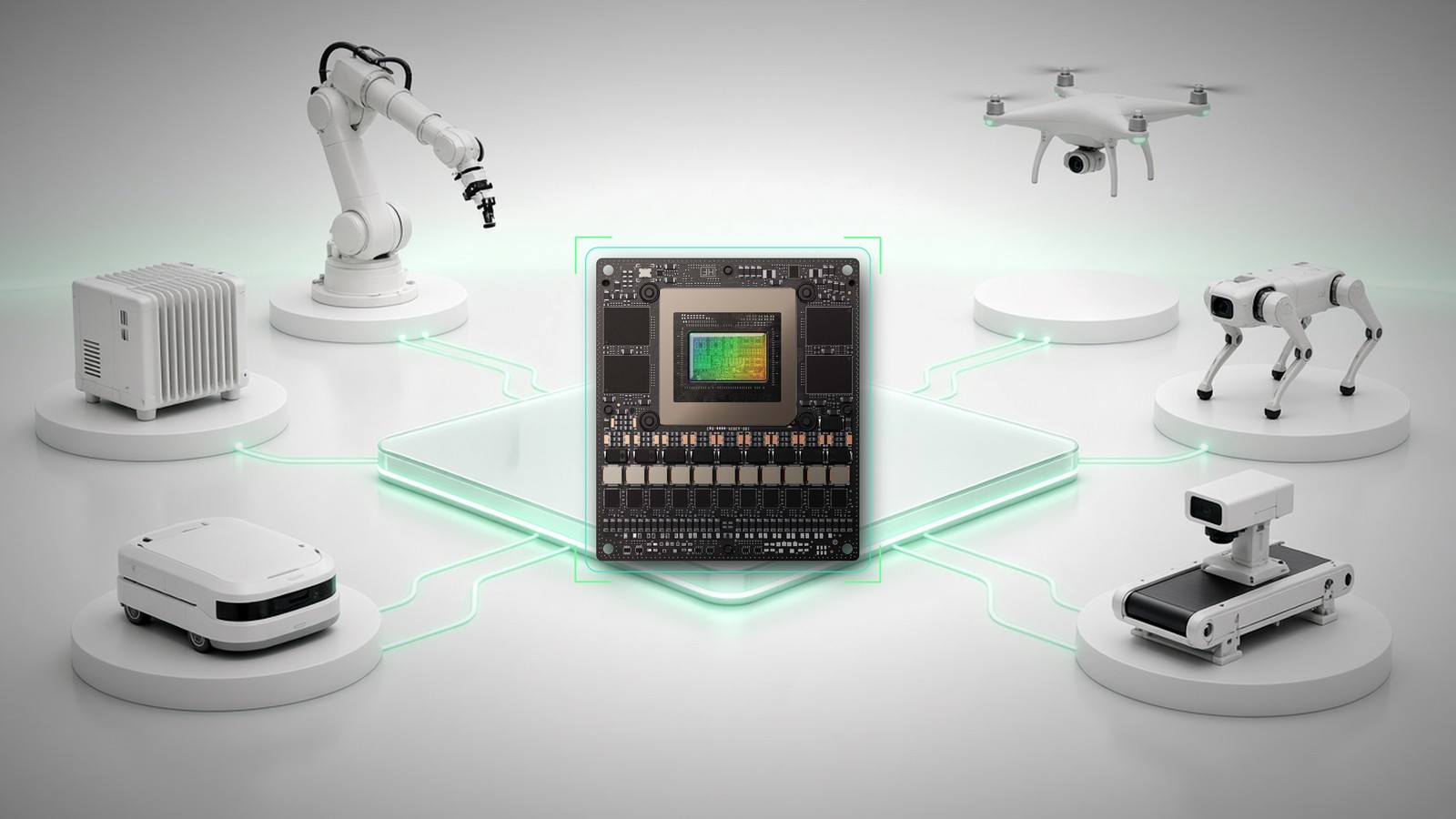
What is Physical AI
Physical AI is AI that takes actions in the real world. In a factory that loop has to close on the device, in real time, and safely. Here is how our four layers map to it.
System 1 · acts
The fast vision-language-action policy that turns what the robot sees and is told into actions on the line.
System 2 · adds context
A slower but accurate domain language model that adds context, planning and explanation to the loop.
Safety · verifies
A deterministic Rust layer checks every command: physical limits, workspace, collision and system state. Fail means no execution.
Actuators · authorized
Only a verified command reaches the arm. Otherwise the model retries, CoreLM proposes an alternative, or the system goes to safe stop.

Both models run together on one edge computer, closing the loop without a cloud round trip.
Products
Edge compute on NVIDIA Jetson Thor. System 1 and System 2 run together on the device, so the loop closes without a cloud round trip.
Learn moreVision-language-action policy. The fast policy that turns what the robot sees and is told into actions on the line.
Learn moreDomain LLM. A slower but accurate domain language model that adds context and reasoning to the loop.
Learn moreDeterministic safety layer in Rust. Every action command passes CoreOS. The model proposes; the system authorizes.
Read the essayAnonymized fleet data improves the base models only with explicit customer consent. Task data and fine-tuning adapters are never shared.
How consent worksSolutions
Robots that work on large, curved and variable parts, where the cost of a wrong action is high.
Welding robots, digital shipyards and humanoids are moving from pilots into production. Our stack is built for robots that work on large, curved and variable hull parts.
Our public research notes look at what an AI heating plan has to respect: temperature limits, heating paths, cooling paths and the resulting microstructure of hull steel.
If the network drops or a cloud call is slow, the robot still has to work. On-device AI keeps the decision loop inside the cell.
A vision-language-action policy understands what it sees and what it is told, so mobile robots can handle variety without a round trip to the cloud.
CoreVLA perceives; CoreLM adds context and explanation. Images and process data never have to leave the building.
CoreEdge brings both models and the CoreOS safety layer onto one Jetson Thor-class computer that can sit inside arms, mobile robots and cells.
Why on-device
Robots act on the line in real time. The decision loop cannot wait on a cloud round trip.
If the network drops or a cloud call is slow, the robot still has to work.
Each customer's task data and fine-tuning adapters stay isolated and are never shared with another customer.
A deterministic layer written in Rust, not the model, checks every action command before it moves the machine.
Running on the device keeps the cost of continuous operation predictable.
"Models can be replicated. Real-world operational data accumulated in production cannot."
Safety Is ArchitectureCustomer stories
Pilot with us
C-Signal · Lab notes
The model never directly controls actuators. CoreOS validates every command against four checks.
Our regular public briefing on welding robots, digital shipyards and humanoids in production.
A Core On view of on-prem plant knowledge agents versus office-centric company brains.
A briefing of public McKinsey, Accenture and IBM reports on industrial agentic AI adoption.
Company
Tell us what your robots need to do, and where the network, latency or data rules get in the way. We'll show you how the stack fits.